Math V: Understanding Decimals
1. What is a Decimal?
You have already learned about fractions — numbers that show parts of a whole. A decimal is simply a fraction written in a special form. For example, instead of writing one-half as ½, you can write it as the decimal 0.5. In 0.5, the zero is in the ones place, and the five is in the tenths place.
The word decimal comes from the Latin word decimus, meaning “tenth,” from the root word decem, which means “ten.” This is because decimals are based on powers of 10.
Decimals are numbers that have two parts:
These parts are separated by a decimal point — the dot that you see between them. For example, in 34.5:
34 is the whole number part.
5 (in the tenths place) is the fractional part.
2. The History of Decimals
The decimal system you use today did not appear overnight. It evolved over many years.
In the 1440s, an Italian mathematician named Giovanni Bianchini used decimal fractions and the decimal point in his astronomical and measurement calculations.
Later, in the late 1500s, Christopher Clavius popularized the decimal point and influenced John Napier, the inventor of logarithms, to use it widely in mathematics.
But even before that, the decimal system had older roots in ancient India and the Arab world. The work of Bianchini, Clavius, and Napier was especially important in shaping the decimal point and making it common around the world.
3. Parts of a Decimal Number
Think of a decimal as having three pieces:
The whole number piece (to the left of the decimal point).
The fractional piece (to the right of the decimal point).
The decimal point (the dot between them).
The fractional part always shows a number less than 1, and it is written to the right of the decimal point. Even a whole number can be written in decimal form by adding a .0 after it. For example, 34 can be written as 34.0.
4. How Decimals Relate to Fractions
Decimals are another way to write fractions that have denominators that are powers of 10 — like 10, 100, 1000, and so on.
0.5 = 5/10 = one-half
0.25 = 25/100 = one-quarter
This makes decimals very useful for expressing parts of a whole in a shorter and easier form.
5. The Decimal Point and Place Value
Decimal Point – This separates the whole number part from the fractional part.
Place Value – Digits to the left of the decimal point are whole numbers (ones, tens, hundreds, etc.). Digits to the right represent parts of a whole:
1st place → tenths
2nd place → hundredths
3rd place → thousandths
Example:
In 12.35:
12 is the whole number part.
3 is in the tenths place (3/10).
5 is in the hundredths place (5/100).
You read this as "twelve and thirty-five hundredths".
6. Types of Decimals
Decimals come in different forms:
Terminating Decimals – These have a fixed number of digits after the decimal point and then stop.
Examples: 0.25, 1.75, 3.0
Non-Terminating Recurring Decimals – These go on forever, but have a repeating pattern.
Examples: 0.3333… (3 repeats), 0.142857142857… (sequence repeats)
Non-Terminating Non-Recurring Decimals – These also go on forever, but without any repeating pattern.
Example: π (pi) ≈ 3.1415926535…
Decimal Fractions – Fractions where the denominator is a power of 10, written as decimals.
Examples: 1/2 = 0.5, 1/4 = 0.25
7. How to Read a Decimal Number
Follow these steps:
Example:
45.6 → “forty-five and six tenths”
7.09 → “seven and nine hundredths”
8. Rules When Working with Decimals
When you work with decimals in operations like division, remember these rules:
9. Why Do We Use Decimals?
Decimals are everywhere in daily life, especially when precision is important:
Money: ₱45.75 is more exact than ₱46.
Weight: You might weigh 35.8 kg, not just 36 kg.
Length: A rope might be 2.35 meters long.
Whole numbers cannot always give you the exact measurement you need, so decimals help show exact values.
10. Quick Summary
Place Value
1. The Idea of Place Value
Every digit in a number has a value depending on its place. The same digit can mean different amounts depending on where it is.
In 4,532, the 4 means four thousand because it is in the thousands place.
In 543.2, the 4 means four tens because it is in the tens place.
2. Whole Number Place Values
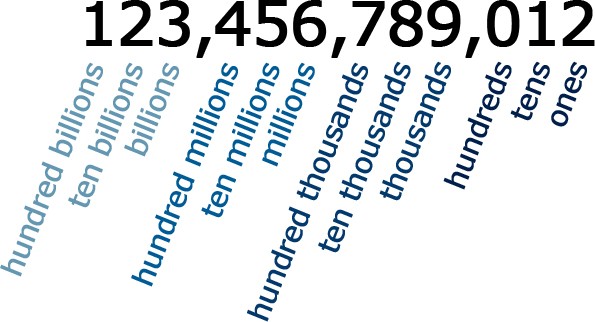
From right to left, the place values are:
Ones (1) – single units
Tens (10) – groups of ten
Hundreds (100) – groups of one hundred
Thousands (1,000) – groups of one thousand
Ten thousands (10,000)
Hundred thousands (100,000)
Millions (1,000,000) and so on.
3. Decimal Place Values
Decimals add places to the right of the decimal point. From left to right after the decimal:
Tenths (1/10)
Hundredths (1/100)
Thousandths (1/1,000)
Ten-thousandths (1/10,000) and so on.

