The Water Cycle: Nature’s Way of Recycling
Water is one of the most important resources on Earth. Without it, no living thing could survive. But did you know that the water we use today is the same water that has been on Earth for millions of years? This is because of a natural process called the water cycle, which continuously recycles water all around the planet.
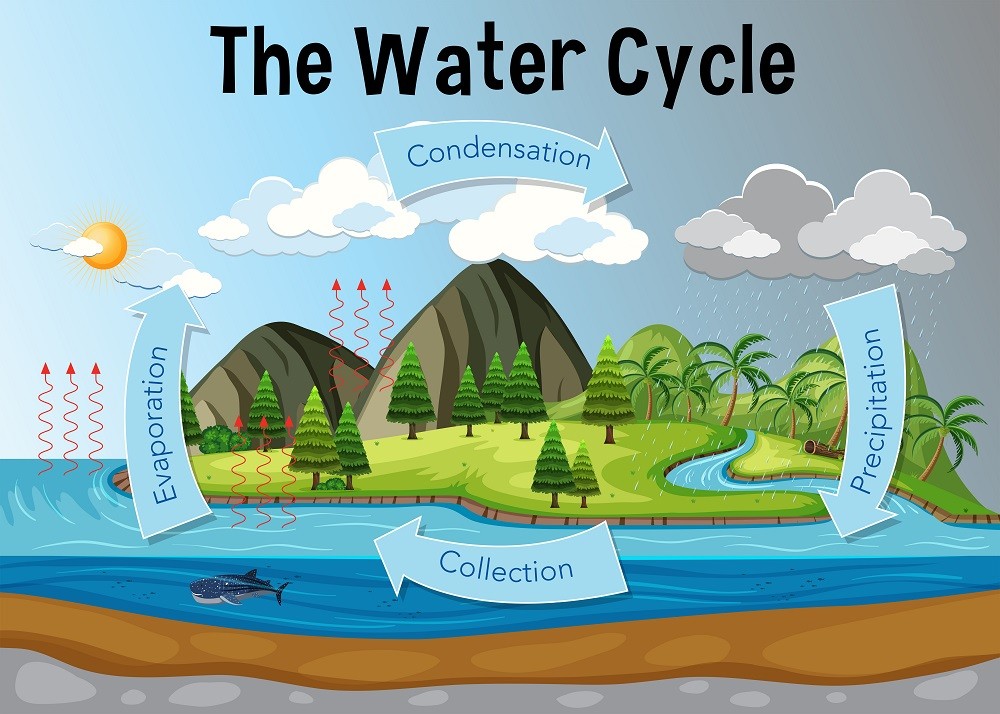
The water cycle has several stages. It begins with evaporation. When the sun heats up rivers, lakes, and oceans, water turns into an invisible gas called water vapor. Next comes condensation. As the vapor rises into the sky, it cools down and changes back into tiny drops of liquid, forming clouds.
When the clouds become heavy with water, precipitation happens. This means the water falls back to Earth as rain, snow, sleet, or hail. The water then flows into rivers, lakes, and oceans, or seeps into the ground, becoming part of the underground water supply. Finally, the cycle repeats itself.
The water cycle is very important because it provides fresh water for drinking, farming, and cleaning. It also helps regulate Earth’s temperature. Without it, life on our planet would not be possible.
Vocabulary Words
evaporation temperature sleet
condensations cycle hail
precipitation underground seep
water vapor survice
regulate recycle
_____1. how hot or cold something is
_____2. the process when water vapor cools and changes
back into tiny drops of liquid, forming clouds
_____3. hard balls of ice that fall from the sky during very
strong storms
_____4. found or happening below the surface of the
ground
_____5. the gas form of water that we cannot see with our
eyes
_____6. to control or keep something steady, like how the
water cycle helps balance Earth’s temperature
_____7. the process in which water changes from a liquid
into a gas because of heat from the sun
_____8. a form of precipitation where raindrops freeze into
small ice pellets before reaching the ground
_____9. a series of events that happen over and over
again in the same order
_____10. any form of water that falls from the sky, such
as rain, snow, sleet, or hail.
_____11. to flow or pass slowly through small holes or
spaces, like water sinking into the soil
_____12. to stay alive, even when facing difficulties or
challenges
_____13. to use something again instead of throwing it
away; in nature, it means to go through a
process that allows materials, like water, to be
used again and again
Comprehension Questions
A. Recall and Understanding
1. What is the water cycle, and why is it important?
2. Describe the process of evaporation.
3. What happens during condensation?
4. In what forms can precipitation fall?
B. Higher-Order Thinking
5. Why do you think the water we drink today is the same
water from millions of years ago?
6. How would life on Earth change if the water cycle
stopped working?